


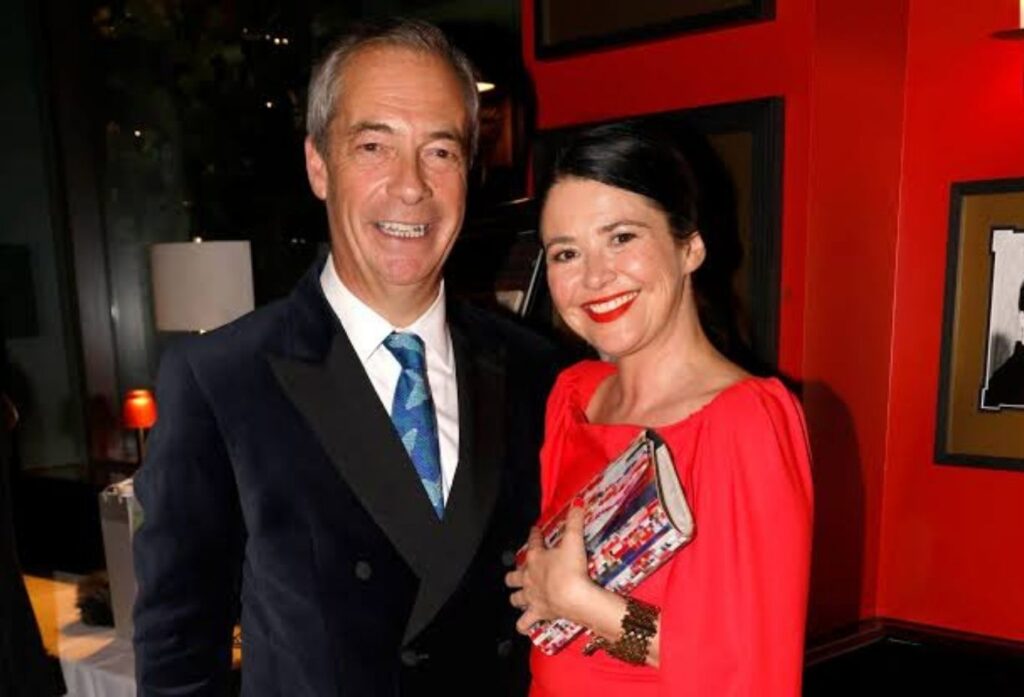
Nigel Farage has been one of the most divisive personalities in the turbulent world of British politics over the past three decades. Farage’s public life has been meticulously examined as the face of the Brexit movement and a well-known figure on talk programs. However, beneath the soundbites and speeches is a private life that has been infrequently examined, and one individual who was present during some of his most formative years: Gráinne Hayes, his first wife.
Although she has largely avoided the public eye, Gráinne Hayes played a critical role in Farage’s life during a period that was characterised by personal recovery, near-death experiences, and the origins of his family. The objective of this article is to compile a biography of Gráinne Hayes that is factual, respectful, and comprehensive, not as a political footnote, but as a genuine individual with her own narrative.
What is the name of Gráinne Hayes?
Gráinne Hayes is most renowned for being Nigel Farage’s first wife; however, her narrative extends far beyond that title. The publicly available information depicts an Irish nurse who was compassionate and capable, and who encountered Farage in extraordinary circumstances.
Early Life and Background
Gráinne Hayes, in contrast to her renowned ex-husband, refrained from soliciting publicity. Her early life, including her birthplace, familial background, and education, are kept confidential. It is verifiable that she was employed as a nurse in the United Kingdom during the mid-1980s, a period in which British hospitals actively sought out Irish healthcare professionals.
This was a time when a significant number of Irish women were employed in nursing positions in London and the South East of England. In this context, her path intersected with that of a young, brazen commodities trader named Nigel Farage.
Although public records do not permit us to verify the hospital in which she worked, Farage’s own recollections and reports indicate that Bromley Hospital or an adjacent South London medical center was the location.
How Gráinne Hayes Met Nigel Farage: A Relationship Born from Crisis
The narrative of Gráinne Hayes’ encounter with Nigel Farage is both poignant and dramatic, and it commences with tragedy rather than romance.
While crossing a road near Orpington, Kent, Nigel Farage was struck by a vehicle in November 1985, at the age of 21. The incident was catastrophic. His head injuries were severe, and his left leg was crushed so severely that doctors contemplated amputation. He was in a state of recovery for months, experiencing both emotional and physical trauma.
Gráinne Hayes entered his life during this period of vulnerability and suffering.
Farage’s own account, as reported by The Telegraph and repeated in numerous reputable profiles, is that he “married the nurse who treated me.” Gráinne Hayes was the name of the attendant. She assisted him in his extended recuperation, and their relationship evolved into something more profound.
Their relationship flourished in the face of adversity. Farage would subsequently assert that the experience “revolutionised everything,” not only physically but also emotionally. The qualities of compassion, steadfastness, and healing that Gráinne Hayes embodied as a nurse must have had a profound impact on the early adult years of the future politician.
Family Life and Marriage (1988–1997)
In 1988, Nigel Farage married Gráinne Hayes after spending several years together. Farage was still employed as a commodities trader in London at the time. They were both young, with him in his early 20s and her slightly older, and they were beginning their lives together in the shadow of his recovery and renewed ambition.
The couple subsequently welcomed two sons:
- Samuel Farage, born in 1989
- Thomas Farage, born in 1991
Hayes is the mother of Farage’s first children. Farage’s opposition to the European Union, which would later define his career, sparked his interest in politics during this period.
Family life was reportedly stable in the early years, despite his developing political obsession. They resided in South London and maintained a low profile. Hayes, on the other hand, maintained her nursing career and concentrated on the upbringing of their children.
Farage has occasionally expressed nostalgia for his early family life, although he rarely refers to Gráinne by name. His pre-political phase was from 1988 to 1997, prior to the emergence of UKIP, Brexit, and the cameras.
Challenges: Pressure, Health, and Life Changes
The years preceding their marriage were already characterised by extraordinary obstacles. Farage experienced an additional significant health scare in 1986, when he was diagnosed with testicular cancer, following the 1985 car accident. Gráinne Hayes was once more present.
She assisted him in the course of his emotional and physical recuperation subsequent to his surgery. According to Farage’s subsequent accounts, this experience served to fortify their relationship. He frequently attributes the ordeal to providing him with “a fresh perspective on life,” although he does not provide any specifics regarding the direct impact it had on their marriage.
Farage’s existence underwent another transformation in the early 1990s. In 1993, he became a member of the newly established UK Independence Party (UKIP), which was a Eurosceptic political organization. He was inevitably drained by the demands of his job, which included long hours, networking, and campaigning.
The family dynamic was significantly impacted by the strain of ambition and ideology, as is the case in many political marriages. After nearly a decade of marriage, the couple divorced in 1997.
The Divorce: 1997
The divorce between Farage and Hayes in 1997 signified the conclusion of a chapter. It appears to have been relatively tranquil there were no public feuds, tabloid scandals, or messy legal disputes. The absence of sensational headlines may be attributed to the fact that both parties appear to have conducted the split privately and respectfully.
Subsequent to the divorce:
- Nigel Farage proceeded to establish his political career and subsequently married Kirsten Mehr, a German national, in 1999.
- Gráinne Hayes maintained privacy for herself and her sons, withdrawing from public life.
There is no public record of her remarrying or making statements about her former husband. The fact that she maintains a low profile implies that she has made a conscious decision to safeguard the serenity of her family and herself.
Life After Divorce: Opting for Privacy Over Publicity
In a time when the erstwhile spouses of politicians frequently become minor celebrities or tell-all authors, Gráinne Hayes opted for silence. There is no known social media presence, no interviews, and no memoirs associated with her.
It is reasonable to assume that she pursued a career in nursing or healthcare, potentially in the United Kingdom or Ireland. Her sons, who are now adults, have also maintained their privacy and have not maintained any verifiable public profiles.
Not only is this intentional privacy comprehensible, but it is also commendable. Numerous individuals who are associated with public figures are compelled to participate in a spotlight that they did not intend to enter. Gráinne Hayes exemplifies the virtue of discretionary dignity by adhering to her boundaries.
The Impact of Gráinne Hayes on Nigel Farage’s Life
The impact of his first wife on Farage’s personal development is undeniable, despite the fact that he rarely discusses her in public. Take into account the timeline:
- He was a young trader who was recovering from a near-fatal injury when he encountered Gráinne Hayes.
- She provided him with assistance during his rehabilitation and significant procedures.
During the decade preceding his political ascent, she served as his companion as he established a family and a sense of purpose.
In essence, she was a component of the initial phase of his adult existence. Despite the fact that Farage is remembered for his politics in history, Gráinne Hayes’s influence during those early, formative years likely influenced the man who would later dominate the public platform.
Media Ethics and Public Curiosity
In the digital era, the lives of political figures and their families are frequently the subject of interminable online analysis. However, responsible reporting necessitates caution, particularly when it pertains to private individuals such as Gráinne Hayes, who have not elected to pursue a public life.
It is important to mention:
- The same limited facts (marriage date, profession, nationality) are recycled by numerous online “celebrity biography” websites.
- Direct interviews or verified records are cited by a mere handful of individuals.
- Some of them even contain false claims, such as fabricated quotations or inaccurate birth years.
Readers should exercise caution when encountering unsubstantiated assertions regarding her life that exceed the documentation provided by reputable sources such as The Telegraph, The Times, or reliable public references like Wikipedia’s citations.
Her narrative serves as a reminder that not all lives associated with renown are public property. Hayes represents thousands of women who discreetly resumed their own lives after providing support to their partners during difficult times.
An Examination of Nigel Farage’s Early Life
In order to gain a more comprehensive understanding of Gráinne Hayes’s role, it is beneficial to briefly examine Farage’s life circumstances during their time together.
Kent, England, was the birthplace of the individual in 1964.
- Education: Attended Dulwich College before departing at the age of 18 to pursue a career in commodities trading.
- 1985: Meeting Hayes during his recuperation from a car accident at the age of 21.
- 1986: Diagnosed with testicular cancer; recovers.
- 1988: Marries Gráinne Hayes.
- Joins UKIP in 1993.
- 1997: Hayes divorces; a new chapter begins in his personal and political life.
Gráinne Hayes was by Farage’s side during this decade, which saw him transition from a recovering patient to a political agitator.
The Symbolism of Their Narrative
In a symbolic sense, their narrative embodies two human qualities: compassion and resilience.
- Farage’s resilience: transforming his energy into ambition and surmounting trauma.
- Hayes’s compassion: embodying the empathy of a nurse who provided him with support during his recuperation.
In the crucible of pain, recovery, and new beginnings, their union was forged, albeit brief in historical terms. Despite the fact that their paths diverged, their shared chapter continues to be a significant aspect of their lives.
Frequently Asked Questions
What is the name of Gráinne Hayes?
Nigel Farage’s initial spouse was Gráinne Hayes, an Irish nurse. They were married in 1988, had two sons, and divorced in 1997.
What is the story behind their encounter?
Gráinne was reportedly one of the nurses who treated Farage during his lengthy recovery after his 1985 automobile accident, during which they encountered each other.
What is her current location?
There is no verified public information available regarding her current residence or activities. She has elected to maintain a private existence, free from the scrutiny of the media.
Did Gráinne Hayes remarry?
There is no public record that confirms her remarriage.
Is there ongoing communication between her and Farage?
There is no publicly available information regarding their continued communication. It is reasonable to presume that both parties maintain separate lives, given their preference for privacy. [Inference]
The Teachings of Gráinne Hayes’s Story
Gráinne Hayes’s narrative provides valuable insights into the intersection of ordinary individuals with extraordinary lives, despite her lack of public recognition.
Private strength is significant.
Quiet resilience is necessary when providing support to an individual during personal reinvention and physical trauma.
Influence is not necessarily public.
Hayes’s influence on Farage’s life may not be prominently featured in the media, but it is interwoven with his narrative.
Privacy is a potent force.
In an era of excessive exposure, the decision to maintain one’s privacy is a demonstration of integrity and self-preservation.
History is enhanced by context.
Understanding the early influences in a political figure‘s life enhances our comprehension of their subsequent actions without necessitating an invasion of others’ privacy.
Balanced Perspective on Media and Public Perception
The media’s portrayal of Gráinne Hayes is consistently respectful, with an emphasis on the fundamental facts:
- Nationality: Irish
- Nursing is my occupation.
- Matrimony in 1988
- Divorce in 1997
- Two offspring
Unlike numerous ex-spouses of high-profile figures, she has never capitalised on or criticised her relationship with Farage. This silence can be interpreted as self-respect, rather than avoidance, as a quiet refusal to allow the world to define her by the fame of another.
Additionally, her absence from the media environment has shielded her from becoming a target of political tribalism. Hayes’s complete withdrawal from public discourse may be one of her most prudent decisions in an era in which every association is politicised.
Cultural Significance and Irish Identity
The background of Gráinne Hayes, an Irish-born nurse who established her existence in the United Kingdom during the 1980s, is indicative of a broader social trend. During that period, the NHS was bolstered by the contributions of thousands of Irish healthcare workers, who served as the foundation of British nursing. Although she is associated with a well-known individual, her narrative also serves as a tribute to the subtle contributions of the Irish diaspora to British society.
The irony is not lost: an Irish woman, who would subsequently campaign to separate Britain from Europe, is providing for an Englishman. However, human stories are not political statements; they serve as reminders of the interconnectedness of individuals’ lives, irrespective of their nationality or ideology.
A Contemplation of the Public Eye, Fame, and Privacy
Gráinne Hayes’s intentional secrecy prompts a critical inquiry: What is our obligation to the public?
Perhaps the answer is inconsequential if we did not select the spotlight ourselves. While Hayes’ name occasionally appears in articles about Farage, she has declined to participate in any public capacity in that narrative. It serves as a reminder that personal boundaries are sacred, even in the face of unrelenting information.
Conversely, Farage’s subsequent relationships and media appearances have been meticulously documented. However, even his most vocal detractors generally demonstrate a degree of respect for the identity of his first wife, possibly due to the fact that she has never solicited commentary.
Conclusion: A Quiet Chapter in a Loud Life
The narrative of Gráinne Hayes and Nigel Farage is characterised by contrasts:
- A politician and a nurse.
- An Englishman and an Irishwoman.
- A public provocateur and a private citizen.
Their paths intersected during a period of vulnerability and recovery, developed into a marriage, and subsequently diverged as life led them in different directions. Gráinne Hayes’s legacy exists quietly in the private realm of family, memory, and self-determination, while Farage’s journey became a matter of public record.
Ultimately, the integrity of a life is what determines its worth, rather than its public profile. Gráinne Hayes has led her life with quiet grace, according to all available accounts.